
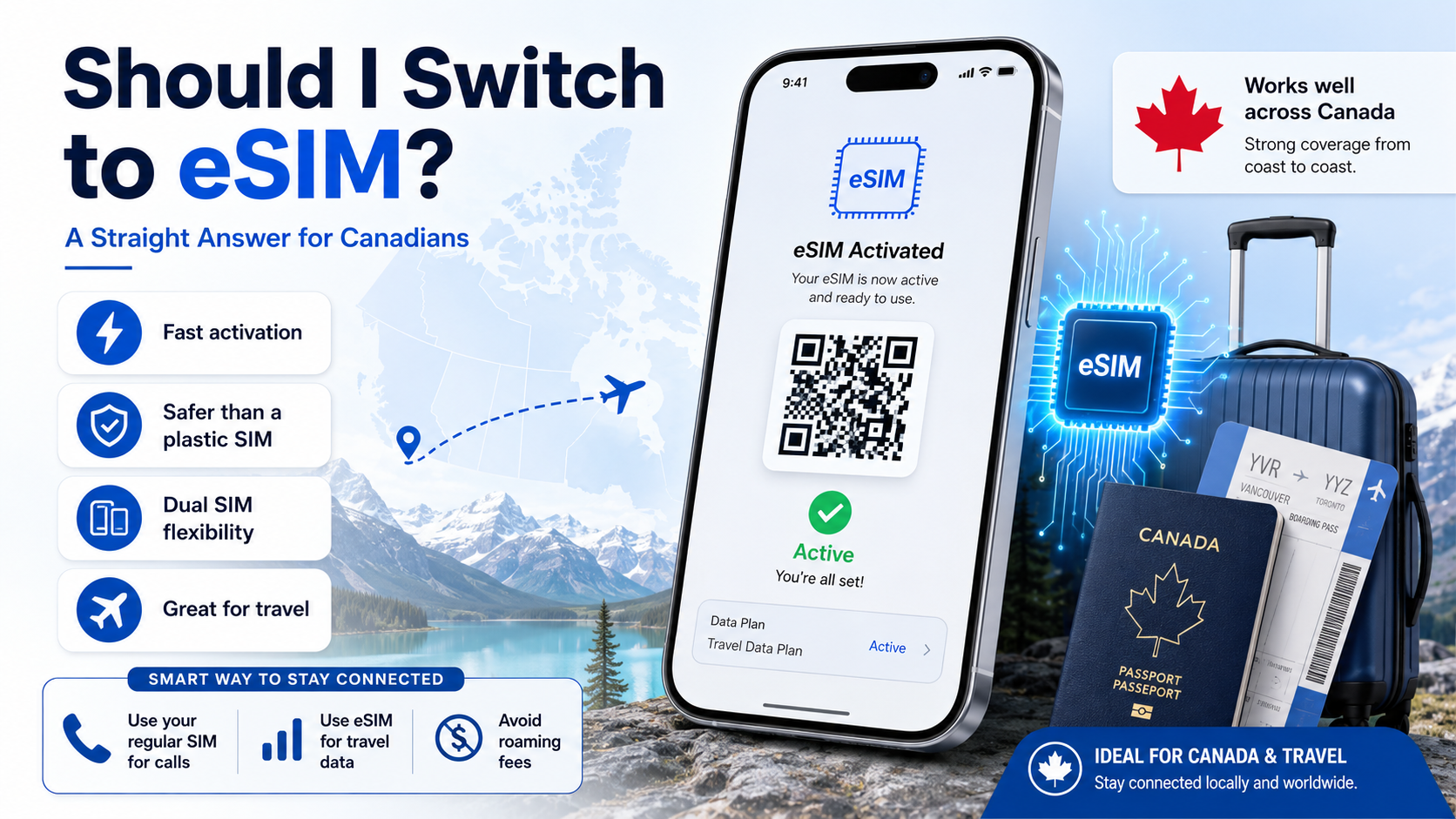
You keep hearing the question: should I switch to eSIM? Here is the short version. If your phone supports it, an eSIM is faster, safer, and better for travel than a plastic card. eSIM stands for embedded SIM, a chip built into your device that stores your carrier profile digitally. The signal that this is the new normal is already here. Apple made every iPhone sold in the United States eSIM-only starting with the iPhone 14 in 2022, removing the physical tray entirely. This guide explains when the switch makes sense, and the rare cases where it does not.
What an eSIM Actually Changes
A traditional SIM is a removable card you slot into your phone. An eSIM does the same job without the plastic. You install a carrier profile through software, usually by scanning a QR code or tapping a link.
The practical difference is speed and flexibility. You can activate a plan in minutes, store several profiles on one device, and switch between them in settings. There is no card to lose, snap, or misplace at the worst possible moment.
Most eSIM-capable phones also keep your physical SIM slot active. That means dual SIM: your home number and a data plan running at the same time, on one handset.
Should I Switch to eSIM? The Honest Verdict
For most people with a recent phone, yes. The convenience gap is now too wide to ignore. But the decision depends on your situation, so weigh these points.
Switch to eSIM if you:
- Own a compatible device released in the last few years.
- Travel and want a local data plan the moment you land.
- Want two numbers, such as work and personal, on one phone.
- Value security, since an embedded chip cannot be pulled out by a thief.
Wait before switching if you:
- Change phones very often and rely on moving one card between devices.
- Own an older or budget handset without eSIM support.
- Depend on a carrier or region that still handles eSIM activation poorly.
The eSIM Situation in Canada
Canada is a special case worth understanding. The three major carriers, Rogers, Bell, and Telus, support eSIM for their own subscribers on compatible phones. Activation usually means requesting an eSIM voucher or QR code and following a short setup.
Visitors face a different reality. Canadian carriers do not sell eSIM plans aimed at tourists, so travellers arriving in the country cannot simply grab a local eSIM at the airport counter the way they might elsewhere.
This matters because Canada is huge. On long drives, in national parks, and across remote regions, reliable coverage is not a luxury. A digital profile that lets you swap networks quickly is a genuine advantage over a single fixed plan.
eSIM Versus Roaming: The One Case That Settles It
Here is where eSIM wins decisively. If you travel to or from Canada, a travel eSIM almost always beats your home carrier’s roaming rates. Roaming charges are the old tax on staying connected abroad, and they add up fast.
A travel eSIM is a data plan you buy online for a specific country or region. You install it before departure and switch it on when you arrive. Providers like Holafly sell a travel esim you can set up in minutes without hunting for a shop or paperwork on arrival.
The workflow is simple: keep your regular SIM for calls and texts on your usual number, and use the eSIM data plan for internet. No surprise bill when you get home.
How to Check If Your Phone Supports eSIM
Before switching, confirm your device is ready. Most modern smartphones released in recent years qualify, including recent iPhones, Google Pixels, and flagship Samsung Galaxy models.
- On iPhone, open Settings, then Cellular, and look for “Add eSIM.”
- On Android, open Settings, then Network and SIM, and check for an “Add eSIM” option.
- Or dial *#06# and look for an EID number, which signals eSIM hardware.
If you are shopping for a new handset, eSIM support is now standard on premium models. Our overview of the latest smartphones shows how connectivity features keep moving toward digital-first design.
How to Make the Switch
The process is short. Ask your carrier to convert your line to eSIM, or buy a travel eSIM plan online. Scan the QR code you receive, install the profile, and label it clearly in your settings.
Keep your old physical SIM until the new profile is confirmed working. Once calls, texts, and data all run correctly, you are done.
Frequently Asked Questions
Will I lose my phone number when I switch to eSIM?
No. Converting your existing line to eSIM keeps your number. A separate travel eSIM adds data without touching your main number.
Can I move an eSIM to a new phone?
Usually yes, though it is not as simple as pulling out a card. Many carriers let you transfer the profile through settings, but some require a fresh QR code.
Does an eSIM drain more battery?
No meaningful difference. An eSIM uses the same modem as a physical SIM, so battery impact is negligible in normal use.
Can I use eSIM and a physical SIM at the same time?
On most dual SIM phones, yes. You can run your home SIM for calls and an eSIM for data simultaneously.
Is eSIM safe if my phone is stolen?
It is safer than a plastic card. A thief cannot remove an embedded chip to dodge tracking or reuse your line.
The Bottom Line
If your phone supports it, switching to eSIM is an easy call. You gain speed, security, and dual SIM flexibility with almost no downside. For anyone travelling across Canada or heading abroad, the savings over roaming alone justify the switch. Check your device today, and make the move on your next plan change.