
Soul CEO Zhang Lu's Team Drives Offline Social Expansion, Launching Co-Branded Bars to Pioneer "Interest-Based Social" Experiences
As social interaction continues to evolve, the younger generation's demand for emotional expression and authentic connection is on the rise. In response to this trend, Soul App CEO Zhang Lu's team is driving the extension of interaction from the online platform into offline settings, answering users' desire for tangible "emotional vessels."
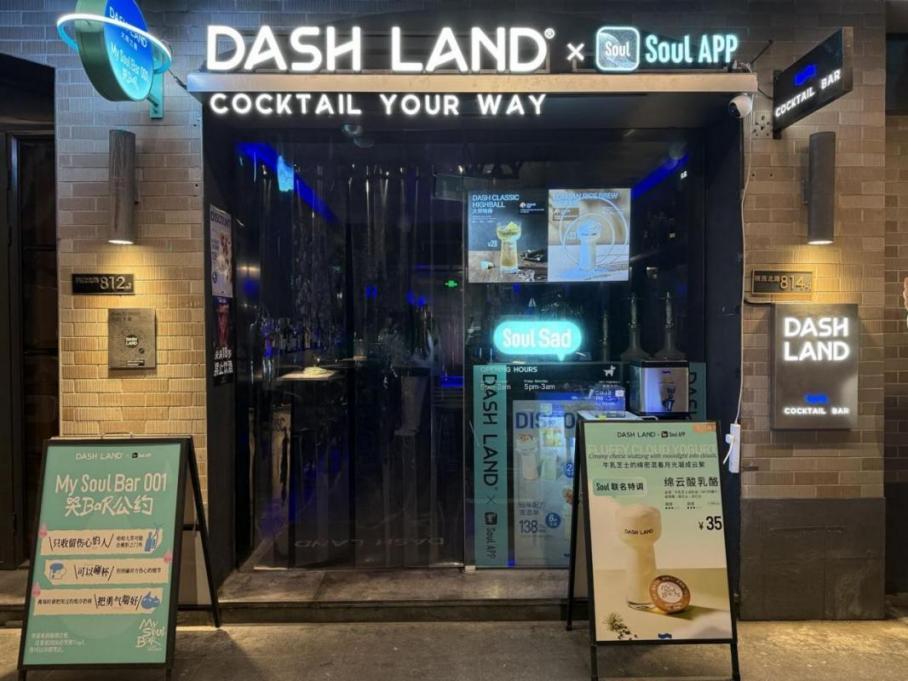
Recently, Soul App and bar brand DASH LAND jointly launched "My Soul Bar," a co-branded bar concept. The project is set to progressively establish at least 30 offline spaces nationwide within the year. Currently, the first seven themed bars are already open across Shanghai, Nanjing, Wuhan, and Kunming.
This initiative goes beyond simple spatial extension — it is a real-world translation of Soul's established social mechanisms. The platform has long championed a "look-beyond-appearances" interaction model, using virtual avatars to lower the threshold for user expression and enabling individuals to release emotions more freely in a relatively anonymous environment. In offline spaces, this logic is further materialized. For example, at the "Masked Bar" in Wuhan, participants interact while wearing famous-painting masks, reducing the interference of first impressions and bringing conversations closer to genuine emotional exchange.
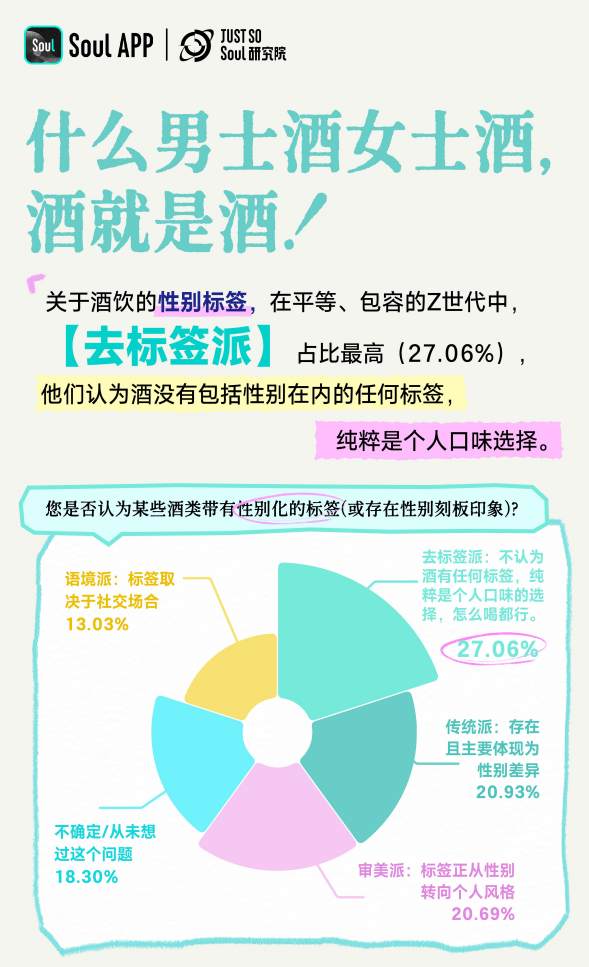
This "label-free" design philosophy resonates with findings from the Just So Soul Research Institute's "Gen Z Drinking Lifestyle Report." The report shows that 27.06% of young people believe the drinking experience should center on taste rather than be defined by stylistic labels. This shift reflects young people's evolving understanding of self-expression and serves as an important basis for Soul's unified product logic across online and offline channels.
In terms of specific venue design, Soul has deconstructed its "interest profile" system and woven it into spatial details. Shanghai's "Cry Bar" features an emotion-releasing outlet composed of onions, guiding users to release suppressed feelings. Nanjing's "Soul Guaranteed Ripe" venue introduces a "One-Hour Friendship Trial" interaction mechanism, lowering the barrier for stranger-to-stranger communication. These spaces are segmented around different emotional needs, forming a multi-layered social structure.
The co-branded bars are divided into an "Emotion Series" and a "Social Series" — the former focusing on personal emotional processing, the latter emphasizing the relationship-building process. This classification not only lowers social barriers but also deconstructs the traditional drinking culture characterized by coercive toasting and forced interaction. In some spaces, discussion content is explicitly restricted — for instance, avoiding specific personal information — to foster a more measured conversational environment.
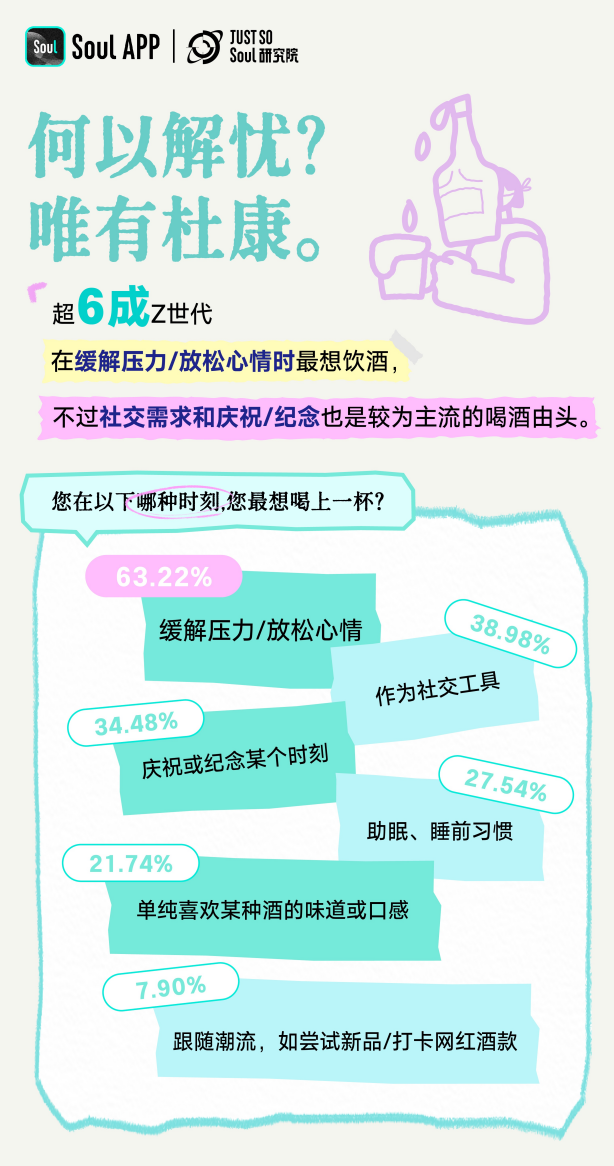
In a broader social context, drinking behavior itself is undergoing transformation. The Gen Z Drinking Lifestyle Report notes that 63.22% of young people cite "stress relief or relaxation" as their primary motivation for drinking. This shift means that drinking is no longer confined to traditional social etiquette but is gradually becoming a form of emotional regulation. Additionally, 58.86% of respondents have transitioned from initial discomfort with alcohol to gradual acceptance, reflecting a recalibration between individuals and their life rhythms. Against this backdrop, Soul's introduction of offline bar settings aims to provide a controlled space with emotional support, rather than a purely transactional venue.
What the Soul × DASH LAND co-branded bars carry is not about drinking itself, but about establishing new forms of connection. Through seven open locations, the platform extends interactions that once resided solely on mobile devices into real-world settings, giving emotional socializing a more concrete anchor.
In this process, Soul CEO Zhang Lu's team, by integrating online mechanisms with offline experiences, has constructed a more continuous social pathway: users can express themselves in online spaces and receive responses in offline environments. This dual-setting synergy allows the platform to expand the practical boundaries of social interaction while preserving its core product identity.